

 … by Taraneh / from Tehran, Iran / MMath Mathematics / 2nd Year (UG)
One of the benefits of studying in a research-intensive university is that you get the chance of meeting academics who in their own fields are quite the superheroes. And if you pay close attention in lectures or workshops or around Magnet Cafe, every single one of them is working on something compelling. And it just takes you to approach them and let them know you are interested in what they are doing and they would happily open your eyes to some fascinating things about our universe.
One of the activities I took part in last semester was volunteering to conduct interviews on academics and their research leading me to learn more about the concept I will soon get to. Obviously, with COVID-19 you cannot interrupt a lecturer or a professor when they get their coffee or in any part of JCMB. So the School is accommodating other means for us to engage with academics outside our circle of lecturers and tutors, and learn more about what is being done in the school other than teaching.
You might be wondering why this is of such importance. But if you, like me, enjoy sitting behind your pile of books and scattered papers with a pencil in hand, trying to figure out and get some form of answer for that problem connecting some of the mathematics together, well that my dear reader, leads you pretty much to research. And who better than those carrying out research to give insight on what it actually is like to do research.
The first time I felt mesmerized by the state I pointed out above was last semester while I was writing a report on Finite Projective Planes. I had to read many books and research papers to get my head around concepts and answer questions along the way to get to a level of confidence in writing that report (which wasn’t an easy task at all!) but none of those was that hard. In fact, the process was more enjoyable than I thought. Think about ‘Spot it!’ game, did you know there is mathematics at work under the hood? I didn’t. But it is called projective planes.
A Projective Plane is a finite incidence structure of points and lines where:
- every two points lie on a unique line,
- every two lines meet at a unique point.
We may also require a non-degeneracy condition; such as there exist four points with no three lying on a line. The simplest example of the projective plane is known as the Fano Plane with seven points and seven lines (the circle counts as a line).
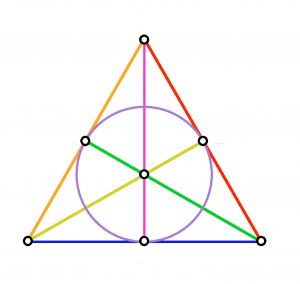
Further, we define the order of a projective plane to be one less than the number of points on any line. So we see that the Fano plane has order 2. And there is this conjecture stating: the order of any finite projective plane is the power of a prime number. If you think about it, it might make sense. It might be true but it might also be wrong and that is something someone needs to prove someday.
Interviewing an academic not only sparked my interest in thinking outside of my own box, it also gave me advice on how to creatively solve the obstacles along the way. And while there is hardship in solving good problems there is also a beautiful connection between concepts and at the end of the day, they all help us understand our world better. I’m thankful that the School of Mathematics are offering opportunities for us to engage with more than the typical syllabus, and for giving us the chance and the means to experience things to help build the future.
You can read Taraneh’s interview from our ‘Academic Interview series’ here: