 … by Taraneh / from Tehran, Iran / MMath Mathematics / 3rd Year (UG)
It was the first lecture of Metric Spaces where the lecturer looked at class and said, “it seems you all are going to be pure mathematicians”. And his remark was right at least in my case. Third year is often the year students start thinking about the future if not sooner, whether you are on a four-year or a five-year journey, the course choices you make will determine what your future will look like. For me those choices were prompted by numbers.
The Prince of Mathematics, Carl Friedrich Gauss once famously said: “Mathematics is the Queen of the Sciences and Number Theory is the Queen of Mathematics.”
This statement, though highly debatable, does find resonance in me and probably many others. What is the reason for such fondness towards the theory of numbers though? This question could be well put to rest by Erdös’ response: “It’s like asking why is Ludwig van Beethoven’s Ninth Symphony beautiful. If you don’t see why, someone can’t tell you. I know numbers are beautiful. If they aren’t beautiful, nothing is.”
Natural numbers are the first interaction we all have with mathematics, these fundamental building blocks, are then extended to integers, reals and finally complex numbers. Problems in number theory often have a very simple language but on the other hand the solution is not often rather sophisticated. For example, take divisibility, one of the most fundamental properties of numbers, the significance and the beauty of divisibility is reflected in prime numbers occupying the centre-stage of number theory research. Consider the following theorem:
Fundamental Theorem of Arithmetic: Every integer greater than 1 can be uniquely expressed as a product of prime, up to the order of the primes. Here is a proof of this theorem but do try to prove it yourself – it’s not too hard.
Incidentally, the reason why 1 is not considered a prime is to keep the above important theorem valid. For if 1 was to be considered a prime then the prime factorisation of any number would not be unique:

What is still so mysterious about primes is that a formula to exactly calculate the nth prime still avoids capture from the sharpest attempts. Note that there have been many advances in unfolding the mystery of primes, one of the most famous one is perhaps the Prime Number Theorem, which supply an approximation of the distribution of primes, but much still remains to come to light. The theorem was solved independently by Hadamard and de la Vallée Poussin in 1996 using ideas introduced by Bernhard Riemann.
The function 
denotes the number of primes not exceeding x. For example:

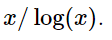
The prime number theorem states that 
It implies that for large x, the number of primes lesser than, or equal to x, will be approximately equal to
You can go and have a look at the proof of this beautiful theorem but be warned, you probably need to learn a lot before you can fully understand it. If you do, you can see that the great difficulty in proving relatively simple results in Number Theory is the motivation for many mathematicians to attempt entering this world. If you are tempted, the good news is that there are many open problems in this field that if you are passionate and brave enough you are more than welcome to sit down and prove!